Yesterday, Suntech announced that it has defaulted on its 3 percent convertible notes.
According to Bloomberg (citingMoody's), "No company has defaulted on publicly traded debt in China since the central bank began regulating the market in the late 1990s."
Suntech was the world's largest manufacturer of solar modules in 2011.
What's Behind Record-Breaking Solar Cell Efficiencies, Part 1 In this two-part series on solar cell efficiencies, we examine laboratory and commercial solar cell efficiencies of Crystalline Silicon, CIGs, Amorphous, Cadmium Telluride and Multijunction Concentrator cells.
California, USA -- In solar, it's hard to go a month without hearing news about conversion efficiencies. In September, for example, Oerlikon Solar and its partner, Corning, said they broke the world efficiency record for a lab-created tandem-junction amorphous-silicon cell. The cell, which was tested by the U.S. National Renewable Energy Laboratory, delivered 11.9 percent stabilized efficiency.
Meanwhile, Conergy said its new selective-emitter technology could boost solar-cell efficiency from one of its German factories by "up to 0.5 percentage points." And scientists at Yonsei University and the Massachusetts Institute of Technology announced new technologies that could one day enhance cell efficiencies by up to 65 percent, in the case of Yonsei, and that could double cell efficiencies, in the case of MIT.
"Everyone's working on efficiency," said Paul Wormser, senior director of product engineering and system solutions at Sharp Electronics' solar division. "You would be hard pressed to find a manufacturer that hasn't stated publicly at least once a year something about an efficiency improvement program."Full article
First Solar Looks Past Success To Even Brighter Future
First Solar Inc. (FSLR) is the world's largest solar-panel maker. Now, it wants to compete with fossil-fuel power generators.
In addition to making flat, glass panels that convert sunlight into electricity, First Solar has built some of the largest solar farms in the U.S. including a 21-megawatt facility in Blythe, Calif., owned by NRG Energy Inc. (NRG) and a 10-megawatt plant in Boulder City, Nev., owned by Sempra Energy (SRE).
First Solar plans to build several more solar farms with a project-development business assembled over the last year through its acquisitions of NextLight Renewable Power LLC in April, a unit of Edison International (EIX), in January and part of privately held OptiSolar last year.
The move is a risky one for the Tempe, Ariz.-based company. First Solar hopes it can leverage its expertise in solar panels to build solar farms capable of taking on gas-fired power plants. The goal: to greatly expand solar power's share of the U.S. power market.
With 2,200 megawatts of solar farms under development, First Solar hopes it can demonstrate that solar power is a reliable, reasonably priced source of valuable daytime electricity. For investors, the company aims to prove that solar farms can be lucrative. ...
Solar power game-changer: 'Near perfect' absorption of sunlight, from all angles
A new anti-reflective coating developed by researchers at Rensselaer Polytechnic Institute could help to overcome two major hurdles blocking the progress and wider use of solar power. The nanoengineered coating boosts the amount of sunlight captured by solar panels and allows those panels to absorb the entire spectrum of sunlight from any angle, regardless of the sun's position in the sky. An untreated silicon solar cell only absorbs 67.4 percent of sunlight shone upon it — meaning that nearly one-third of that sunlight is reflected away and thus unharvestable. After a silicon surface was treated with Lin's new nanoengineered reflective coating, however, the material absorbed 96.21 percent of sunlight shone upon it — meaning that only 3.79 percent of the sunlight was reflected and unharvested. This huge gain in absorption was consistent across the entire spectrum of sunlight, from UV to visible light and infrared, and moves solar power a significant step forward toward economic viability.
Solar Pebble could light the way for rural Africans
A solar-charged light might seem like just another green gadget to the average American, but for families in rural Africa, it could prove revolutionary. Product design consultancy Plus Minus Design is vying to replace unsustainable and potentially dangerous lanterns in the homes of off-grid Africans with the Solar Pebble. Engineered with the economic constraints of developing-world citizens in mind, the Solar Pebble will provide one hour of LED light for every two hours of charge, and will cost only $2.70 to manufacture. Source: CNET
Solar-powered boat Türanor raises hopes of a sun-fuelled future
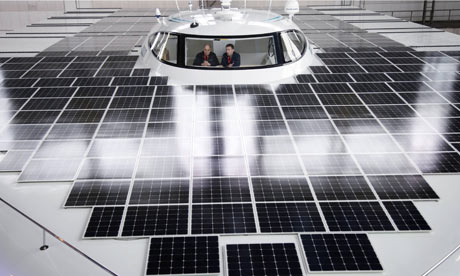
Considering its 85 tonnes and its potential to shape the future of maritime travel, the launch of Türanor was a surprisingly reserved affair. The world's largest solar-powered boat made a gentle plop as it was lowered by a huge crane on to the waters of the Kiel firth in northern Germany today, and triggered the polite applause of onlookers – mainly fishermen and shipyard workers. "We've made it, she's safe, and she floats," whispered its owner, Immo Ströher, with tears welling in his eyes.
But the real challenges for the gleaming white catamaran still lie ahead, as its makers seek to use it to prove that the sun can fuel our world.
Next year, after an intense testing phase, Türanor – the name, inspired by JRR Tolkein's Lord of the Rings, means "power of the sun" – will embark on her maiden voyage, a round-the-world trip during which her two-man crew will attempt to chase the sun in order to capture as much available solar power as possible and navigate her at an average speed of 7.5 knots.
Ströher's granddaughter christened her today by smashing a bottle of champagne against her teak deck, and pronouncing: "May you always have plenty of water under your bows, and sun on your deck."
Staples Inc., the Framingham-based office products retailer, said it held a dedication ceremony yesterday to unveil the largest single rooftop solar power installation in Maryland at the company’s 200,200-square-foot fulfillment center in Hanover.
“The 1.01 megawatt solar installation covers nearly 175,000 square feet of roof space, larger than three football fields,’’ Staples said in a press release; the release said the installation demonstrated the company’s commitment to environmental issues.
The event was co-hosted by SunEdison, a solar energy services provider that worked with Staples on the project.
Japan's Sharp Corp (6753.T: Quote, Profile, Research) said it will set up a joint venture with Enel (ENEI.MI: Quote, Profile, Research) and STMicroelectronics (STM.PA: Quote, Profile, Research) by March to make solar cells in Italy, in a bid to further tap the strong growth potential of renewable energy sources.
Consumer electronics maker Sharp and Italian utility company Enel in 2008 announced their intention to make thin-film solar cells with a European manufacturer, but they did not identify the third company.
The venture plans to start producing solar cells in early 2011 at STMicroelectronics' existing facility in Sicily at an initial output capacity of 160 megawatts a year, which will eventually be raised to 480 megawatts.
In addition to bank loans, each of the joint venture partners will invest up to 70 million euros in the project, Sharp said in a statement.
The venture will be owned a third each by Sharp, Franco-Italian chip maker STMicroelectronics and Enel Green Power, an Enel group company.
Key Developments For Suntech Power Holdings Co, Ltd
Suntech Power Headlines in Reuters.com:
Suntech Power Holdings Co., Ltd. Signs 17 MW Deal With Ontario Installer-Reuters Tuesday, 1 Dec 2009 06:08pm EST Reuters reported that Suntech Power Holdings Co., Ltd. has landed a 17 megawatt supply deal for 2010 with Canada's Pure energies, the Company said. Under the deal, Toronto-based Pure energies, which installs, leases and operates solar power systems, will market and use Suntech's panels for residential solar systems in Ontario. Financial terms of the deal were not disclosed. The companies said in a statement their memorandum of understanding continues through 2011.
Suntech Power Holdings Co., Ltd. Tie Up In 115 MW Sales Deal-Reuters Tuesday, 3 Nov 2009 07:51pm EST Reuters reported that Suntech Power Holdings Co., Ltd. will sell 115 megawatts worth of solar panels in 2010 to EDF Energies Nouvelles. The panels will head to enXco's projects in the United States and Canada for rooftop and utility-scale projects, enXco in a statement.
Suntech Power Holdings Co., Ltd. Collaborates With AEDB To Deliver Solar To Pakistan Thursday, 15 Oct 2009 06:30am EDT Suntech Power Holdings Co., Ltd. announced that it has entered into a memorandum of understanding (MOU) with Pakistan's Alternative Energy Development Board (AEDB) to work towards the widespread use of solar energy technologies to meet the energy shortage in Pakistan. The objective of the MOU is to facilitate cooperation between Suntech and the public sector and private companies in Pakistan to help implement solar programs including the AEDB's Rural Electrification Program; the development of Solar Power Pumping Systems with the AEDB and the World Bank; and Solar Power Telecom Projects in collaboration with Pakistani telecom companies. The MOU sets forth the agreement in principle of the parties concerning the project and related activities. Final agreement between the parties is subject to the negotiation and execution of definitive agreements among the parties.
Suntech Power Holdings Co., Ltd. Launches 60 Cell Module For Residential and Commercial Rooftop Systems Monday, 21 Sep 2009 02:00am EDT Suntech Power Holdings Co., Ltd. announced the introduction of a 60 cell multi crystalline PV module to be marketed under the product name Wd. The new Wd module series features positive peak power tolerance of 0/+5 watts, which will assure that all Wd modules will produce at, or outperform, the nominal power rating. Full Article
Sanyo develops solar cell that’s thinner than hair
Sanyo is in the news today, and again it’s about the company’s green tech power. The company today announced [JP] it will do everything to become Japan’s top player in the domestic solar industry by 2012 and eventually one of the top three solar companies on a global level. At the same time, the Nikkei reports [registration required, paid subscription] that Sanyo has succeeded in developing a solar cell that’s thinner than a human hair.
The company says it will benefit greatly from a new feed-in tariff program by the Japanese government introduced this month for green energy firms. Another factor for Sanyo’s self-confidence should be the speed with which it innovates. Their new prototype solar cell is just 58 micrometers thick, about one-fourth of most solar cells currently out there. (
Back in 2007, Dow Chemical (NYSE: DOW) won a $20 million grant from the Department of Energy to research and develop building-integrated photovoltaics (BIPV) products. The fruits of that government-sponsored labor are Dow's Powerhouse Solar Shingle, which the company is bringing to market in partnership with solar-cell shop Global Solar Energy and homebuilders Lennar (NYSE: LEN) and Pulte Homes.
Other firms active in BIPV include Suntech Power (NYSE: STP), Energy Conversion Devices (Nasdaq: ENER), and Ascent Solar (Nasdaq: ASTI), which is a bit further behind Global Solar in the commercialization of thin-film copper-indium-gallium-diselenide (CIGS) solar cells on a flexible substrate. Compared to the headline-grabbing utility-scale projects of First Solar (Nasdaq: FSLR), BrightSource Energy, and others, BIPV hasn't given investors much to get fired up about lately.
Dow may aim to change that. The company projects $5 billion in revenue by 2015, and $10 billion to $11 billion by 2020. That's just for the Powerhouse shingle, ostensibly the first of more BIPV products to come.
The key source of Dow's enthusiasm appears to be its claim that the shingle will be 30%-40% cheaper than current BIPV solutions, and 10%-15% below the per-watt installed cost of conventional rooftop panels.
NEW YORK (Reuters) - Dow Chemical Co said on Monday it would begin selling a new rooftop shingle next year that converts sunlight into electricity -- and could generate $5 billion in revenue by 2015 for the company.
The new solar shingles can be integrated into rooftops with standard asphalt shingles, Dow said, and will be introduced in 2010 before a wider roll-out in 2011.
"We're looking at this one product that could generate $5 billion in revenue by 2015 and $10 billion by 2020," Jane Palmieri, managing director of Dow Solar Solutions, told Reuters in an interview.
The shingle will use thin-film cells of copper indium gallium diselenide (CIGS), a photovoltaic material that typically is more efficient at turning sunlight into electricity than traditional polysilicon cells.
Dow is using CIGS cells that operate at higher than 10 percent efficiency, below the efficiencies for the top polysilicon cells -- but would cost 10 to 15 percent less on a per watt basis.
China's Suntech Power Holdings Co Ltd (STP) will overtake Germany's Q-Cells AG (QCEG.DE) as the world's largest producer of solar panels this year, according to a report issued on Monday by industry research firm iSuppli.
Suntech, Japan's Sharp Corp (6753.T), and China's Yingli Green Energy Holding Co Ltd (YGE.N) and JA Solar Holdings Co Ltd (JASO) are defending their market positions by continuing to increase production "as if a recession had never occurred," iSuppli analyst Henning Wicht said in a statement.
Meanwhile, producers including Q-Cells, U.S.-based SunPower Corp (SPWRA.O) and Britain's BP Solar (BP.L) have cut output or expansion plans in response to a massive oversupply of solar panels and cells that is driving down prices.
Nearly half of all solar panels made in 2009 will not be sold this year due to the solar supply glut, iSuppli said.
Total solar panel production will rise to 7.5 gigawatts (GW) this year, up 14.3 percent from last year, the report said. However, only 3.9 GW of solar installations will take place in 2009.
Latest developments on Solar Panel efficiency, and the ever shrinking costs of silicon and thin film solar panels will bring someday what is known as Grid Parity, a price barrier where Solar becomes as cheap as conventional fossil fuel sources of energy(mainly the coal and gas power plants)
Moore’s law does apply to solar panel technology and grid parity might be coming sooner than later.
Some recent articles commenting on these matters:
The Shining: Solar Power, Grid Parity, and the Cost of Power
Clean energy has a holy grail—the day when the electricity produced by solar panels and the like can compete dollar-for-dollar with electricity churned out by traditional power plants.
That day is getting closer all the time. But as Lux Research notes today in a new report, so-called “grid parity” isn’t a done deal yet, and still depends on such fickle factors as the amount of sunlight hitting rooftops and political will to underwrite hefty subsidies for solar power.
The Lux report, “The Slow Dawn of Grid Parity,” stresses a few main points. Solar power is now measured by the cost of the electricity it produces, rather the cost of installing the stuff in the first place.
That makes a big difference for consumers, utilities, and investors, Lux says, since it makes it a lot easier to compare apples with apples. That’s because solar power (like wind) costs a lot upfront, but has free fuel—so it looks more attractive when measured by the electricity it actually produces.
Grid parity represents something of a Holy Grail for solar companies — a point where they can compete on cost with conventional fossil fuel sources of energy. The race for grid parity shifted into overdrive earlier this year as a heap of new funding and the extension of tax credits were approved as part of the stimulus package. According to a new report released today from Lux Research, certain types of solar installations are now on the verge of grid parity — especially in California — but accelerating progress toward that Holy Grail has in some ways never been more at risk.
Light-absorbing nanowires may make better solar panels BY DAVID ORENSTEIN
A century after German physicist Gustav Mie derived the math to explain why the colors in some stained glass windows look especially resplendent in the sunlight, a team of Stanford engineers has built upon his work to potentially improve a means of harvesting energy from the sun.
In 1907 Mie realized that tiny metal particles in stained glass scattered light in ways that produced beautiful colors. Now, a related interplay between light and matter explains why incredibly thin "nanowires" made of semiconductors like germanium may prove to be effective components for solar cells. Combining Mie's work with more recent theory, the Stanford team has discerned how to tune and improve the light absorption efficiency of the wires. Their research appears in the July 5 online edition of the journal Nature Materials.
Wells Fargo & Co. and SunPower Corp. on Monday announced a collaborative effort to fund up to $100 million in SunPower commercial-scale solar systems.
San Francisco-based Wells (NYSE:WFC) and San Jose-based SunPower (NASDAQ:SPWRA) and (NASDAQ:SPWRB) said SunPower will enter into power purchase agreements with qualified customers and Wells Fargo will finance the solar power systems that SunPower will design, build, operate, and maintain.
Customers hosting the systems will buy the electricity from SunPower "at prices that are competitive with retail rates, providing them with a long-term hedge against rising power prices and the ability to take advantage of the environmental and financial benefits of solar power with no initial capital investment," the companies said.
First Solar is starting to show how cheap thin-film solar panels can revolutionize the industry, with the main issue being the low prices of cadmium telluride solar panels.
First Solar Inc on Wednesday said it expected to cut manufacturing costs by a third or more over the next five years, mainly by making its solar panels more efficient at transforming sunlight into electricity.
In a presentation to analysts in Las Vegas, First Solar President Bruce Sohn said the company's manufacturing costs would fall to between 52 cents and 63 cents per watt by 2014. In the first quarter of this year, the company's cost per watt was 93 cents.
Reducing the cost of solar power is key to making the clean energy source competitive with electricity generated from coal and other fossil fuels.
First Solar currently produces the lowest cheapest panels in the industry. They are made from cadmium telluride rather than the higher-priced polysilicon that is the main raw material in traditional solar panels.
The drawback to First Solar's panels, however, is that they are less efficient than silcon-based panels.
The European project known as Desertec is nothing if not ambitious.
It aims to harvest the sun’s energy — using a method known as concentrating solar power, or C.S.P. — from the vast North African desert and deliver it as electricity, via high-voltage transmission lines, to markets in Europe. Eventually, its backers say, it could satisfy as much as 15 percent of the European Union’s power needs. ... As James Kanter reported in our Green Inc. blog, the project took a step forward last week when a consortium of German businesses announced plans to pursue financing and otherwise hammer out details for Desertec, which is expected to cost about €400 billion, or $555 billion.
Lend Lease Announces 10 MW Supply Agreement with First Solar
By Chip Brian, SmarTrend Analytics Team Lend Lease announced Monday that its construction and project management business, Bovis Lend Lease, has signed a supply agreement with First Solar (NASDAQ:FSLR) for 10MW of solar panels. Lend Lease hopes to leverage this relationship in its Australian construction business as well as its existing development portfolio. Bovis Lend Lease's Australian CEO Tony Costantino said, "We are pleased to be working with First Solar, one of the leading solar companies, and to be entering the solar procurement market. This relationship allows us to meet the growing demands in renewable energy for our clients and ensures that solar energy is a consideration on every project. We look forward to working together on future opportunities." He continued, "First Solar's panels are perfectly suited for Australia's climate because they perform better than other PV technologies in high temperatures."