Are we on the cusp of a solar energy boom?
The total solar energy hitting Earth each year is equivalent to
12.2 trillion watt-hours. That's over 20,000 times more than the total energy all of humanity consumes each year.
And yet photovoltaic solar panels, the instruments that convert solar radiation into electricity, produce only 0.7 percent of the energy the
world uses.
Continue reading:
The Week
Labels: Solar Energy, Solar Technology
Energy Project See Solar as Easier Than Wind
“The solar comes a bit easier,” said multinational energy giant Macquarie Group’s (NYSE:MIC)
Managing Director Thomas Houle at the Texas Renewable Energy Industry Association (TREIA) Renewable Energy Finance Forum. “But it does present unique challenges. One is land rights and producing a clean title.”
In markets where developers are unfamiliar with commercial and utility-scale solar, he said, “there can be a view that issues like mineral rights will sort themselves out. But when you get to financing, there is nothing more important than having a clean title and good title insurance.”.
With a wind project, it is less crucial, he said, “because you are not covering the vast majority of the land area with equipment. You’re only using 2 percent to 5 percent of your land area for all the roads and foundations and the rest.”
Source:
Green Tech MediaLabels: Solar Energy, wind energy
3D Printing self-assembling solar panels
New research towards low cost 3d Printing of thin film solar panels.
Scientists from Imperial College London, working at the Institut Laue-Langevin, have presented a new way of positioning nanoparticles in plastics, with important applications in the production of photovoltaic material.
This will result in more low-cost tools for 3D printing of self-assembling, thin-film circuits.
Read more at:
Nano Tech StocksLabels: 3d printing, Nano Solar, Solar Energy, Thin film solar cells
Behind Record-Breaking Solar Cell Efficiencies
 What's Behind Record-Breaking Solar Cell Efficiencies, Part 1
In this two-part series on solar cell efficiencies, we examine laboratory and commercial solar cell efficiencies of Crystalline Silicon, CIGs, Amorphous, Cadmium Telluride and Multijunction Concentrator cells.California, USA -- In solar, it's hard to go a month without hearing news about conversion efficiencies. In September, for example, Oerlikon Solar and its partner, Corning, said they broke the world efficiency record for a lab-created tandem-junction amorphous-silicon cell. The cell, which was tested by the U.S. National Renewable Energy Laboratory, delivered 11.9 percent stabilized efficiency.
Meanwhile, Conergy said its new selective-emitter technology could boost solar-cell efficiency from one of its German factories by "up to 0.5 percentage points." And scientists at Yonsei University and the Massachusetts Institute of Technology announced new technologies that could one day enhance cell efficiencies by up to 65 percent, in the case of Yonsei, and that could double cell efficiencies, in the case of MIT.
"Everyone's working on efficiency," said Paul Wormser, senior director of product engineering and system solutions at Sharp Electronics' solar division. "You would be hard pressed to find a manufacturer that hasn't stated publicly at least once a year something about an efficiency improvement program."
Full articleLabels: CIGS, Polysilicon, solar efficiency, Solar Energy, solar panels
Solar market drops, but will recover
American thin film manufacturer First Solar ‒ top international producer of PV cells for 6 consecutive quarters ‒ lost ground in the third quarter of 2010, increasing capacity by just 2% and moving into third position behind Chinese companies Suntech and JA Solar.
Revealing this development in its latest analysis, IMS Research is predicting that even though demand will weaken in 2011, First Solar will gain market share when it increases production capacity through new production facilities that are expected to start up over the next two years.
First Solar recently announced that it would be expanding capacity by opening two additional four-line plants in the United States and Vietnam in 2012, in addition to previously announced expansions in France, Germany and Malaysia.
Renewableenergyworld.com reports that these expansions would suggest that the thin film supplier’s production capacity will reach over 2.7 GW by the end of 2012 at current line run rates. However, given its history of improving throughput, IMS Research estimates that its capacity could in fact reach over 3 GW by then.
IMS PV research analyst Sam Wilkinson commented: “While much of the industry has indicated uncertainty and a possible reduction in demand in 2011, with Germany’s small commercial segment likely to decrease the most in MW terms, First Solar is expecting an increase in demand for its products and a need to accelerate capacity expansions.”
Full articleLabels: First Solar Inc, FSLR, Solar Energy, Solar Stocks
PG&E partners with SunRun to finance home solar photovoltaics
PG&E Corp. is partnering with yet another Bay Area solar company, investing $100 million to help pay for the installation of more than 3,500 home photovoltaic arrays.
This time, the parent of the Pacific Gas & Electric utility is pairing with San Francisco-based SunRun Inc. to create a tax equity fund. But the company had already stepped into the banker role in January, when it put $60 million into a similar fund for Foster City-based SolarCity Corp.
Pacific Energy Capital II, a subsidiary of PG&E, will manage the financing vehicle, which the companies claim is the largest of its kind to date.
SunRun, which like SolarCity offers solar leases to homeowners, will use the money too install panels throughout 2010 and 2011 in at least five states, including Arizona, California, Colorado, Massachusetts and New Jersey. The PG&E subsidiary will get any government tax credits associated with the home projects.
Once the panels are installed – at low or no cost to homeowners – SunRun owns the photovoltaics while customers pay a set rate for the generated power. The arrays would otherwise cost tens of thousands of dollars for homeowners to buy outright and install.The announcement is the latest in a string of developments in the home solar leasing market. SolarCity revealed a $90 million fund with U.S. Bancorp Community Development Corp., a division of U.S. Bancorp, in March. Homebuilder Lennar Corp. said last week that it was partnering with SunPower Corp. on a solar leasing option for some of its homes.
SourceLabels: solar cells, Solar Energy, Solar Projects, SunRun
Panasonic Entry into Solar Power
The Panasonic Group will launch on July 1, 2010 its HIT(R) 215 Series* household solar power generation systems, the first series of collaborative products to be developed since SANYO became a part of the Group. The launch signifies how the newly extended group has combined its collective strengths for a full-scale entry into the solar cell business.
Since the announcement of the capital and business partnership with SANYO in December 2008, Panasonic has established a Collaboration Committee and promoted discussions, under all applicable laws and regulations, to maximize the potential synergy effects within the new Panasonic Group. Following the subsequent formalization of this takeover on December 21, 2009, 27 different sub-working groups have engaged in more advanced discussions, and the HIT 215 Series household solar power generation systems, featuring HIT 215 solar power generation modules with the world's highest-level energy conversion efficiency, represent the first tangible fruit of these collaborative efforts.
The new products combine SANYO's solar power generation modules with Panasonic's energy management technology, construction materials, and electrical technology, and will be broadly promoted across the companies' various sales routes, including home appliances, electrical and construction products. In doing so, the Panasonic Group is seeking to maximize its combined strengths to achieve significant business expansion within the rapidly growing solar power generation market, and aims to establish a position as the top manufacturer in the market with a target share in Japan of at least 35% by 2012.
SourceLabels: Panasonic, solar cells, Solar Energy, Solar power
Japan Solar Sail

Today the Japan Aerospace Exploration Agency (JAXA) is set to launch the first spacecraft that will speed across the solar system using a hybrid solar sail—one propelled partly by solar pressure, partly by traditional solar power.
Dubbed Ikaros—for Interplanetary Kite-Craft Accelerated by Radiation of the Sun—the experimental craft will launch from the Tanegashima Space Center at 5:44 p.m. ET (6:44 a.m. Tuesday, local time).
Ikaros is hitching a ride into space aboard an H-IIA rocket, piggybacking with JAXA's Akatsuki Venus Climate Orbiter mission.
Once in space, the cylindrical, 677-pound (307-kilogram) craft will separate from the rocket and spin itself to unfurl its roughly 46-foot-wide (14-meter-wide) solar sail. (Related blog: "Tiny Solar Sail Pitched to Clean Up Space Junk.")
First proposed in the 1920s, solar sails are large reflective membranes that allow a spacecraft to be pushed by radiation pressure from sunlight, negating the need for heavy onboard fuel. (Explore a time line of space travel milestones.)
"It's the space equivalent of a yacht sailing on the sea," said Yuichi Tsuda, deputy project manager for Ikaros. Like wind filling a boat's sails, particles of light—or photons—streaming from the sun bounce onto a mirrorlike aluminized solar sail.
As each photon strikes, its momentum is transmitted to the spacecraft, which begins to gather speed in the almost frictionless environment of space. A solar sail can eventually reach speeds five to ten times greater than a rocket powered by conventional fuels.
Source:
National GeographicLabels: Japan, Solar Energy, Solar News, Solar Technology
Dazzling future for Solar Power
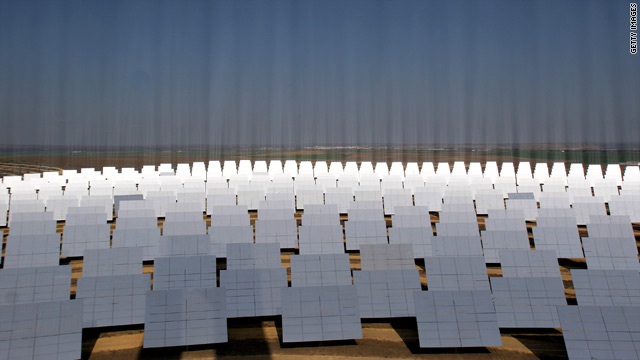
"Concentrating solar power plants like the PS10 near Seville, Spain may provide around 10 percent of world electricity by 2050"
Solar power is expected to provide almost a quarter of the world's electricity supplies by 2050, according to a new report published by the International Energy Agency (IEA).
Eleven percent of total supplies are predicted to come from solar panels on homes and offices while a further 11 percent will be provided by central solar power stations feeding clean electricity to populous areas.
Solar power currently accounts for 0.5 percent of total electricity supplies, but this will need to rise if cuts in carbon emissions are to be achieved, according to the IEA.
Executive director of the IEA, Nobuo Tanaka said in a statement: "The combination of solar photovoltaics and concentrating solar power offers considerable prospects for enhancing energy security while reducing energy-related CO2 emissions by almost six billion tonnes per year by 2050."
The future success of solar power stations (known as Concentrating Solar Power or CSP) will depend on the development of "dedicated transport lines," but the IEA predict that it could become competitive with coal and nuclear power plants by 2030.
The IEA expects North America to be the largest producer of CSP electricity, followed by India and North Africa -- which will likely export half of its output to Europe.
Source:
CNNLabels: Global Solar Energy, Solar Energy, Solar power, Solar Technology
Thin Film 2010: Market Outlook to 2015

From only 17 megawatts in 2002 to nearly 1 gigawatt in 2008 (a compounded annualized growth rate of 96%), thin film’s rise over the last decade has been remarkable indeed. The search for alternative technologies to traditional crystalline silicon PV has led to a tidal wave of investment and entrepreneurial activity in thin film, with 170 active companies and over $2 billion in VC investment in the space. However, as of 2010, only two thin film companies have produced in excess of 100 MW annually.
Full ArticleLabels: CIGS, First Solar Inc, FSLR, Solar Energy, Solar Stocks, Solar Technology, Thin film solar cells
United States Renewable Energy Sector Is Falling Behind The Rest Of The World
As China and Europe implement policies to encourage clean energy market growth, US clean energy companies are focusing their efforts overseas - resulting in lost jobs and opportunities in the US. Analysts believe that unless the US government does more to encourage job and market growth in the clean energy sector, that the country will fall behind China and Europe in achieving a global leadership position in this growing market sector. See the following article from Money Morning for more on this.
If the United States doesn't take drastic measures to engineer new clean energy policies and investment initiatives, it will continue to take a back seat to China and Europe, which are driving the clean energy market toward a profitable future.
Both clean energy companies and a skilled workforce are heading overseas, where government policies are creating a more welcoming and promising market for clean energy products.
Take Massachusetts-based Evergreen Solar, Inc (Nasdaq: ESLR). In 2008, it used $58 million in government aid to open a new Massachusetts factory to build silicon wafers and cells and assemble solar panels. But in November 2009, it announced the assembly of solar panels would be moved to Wuhan, China, where solar panel manufacturing will cost far less than in the United States.
SourceLabels: ESLR, Evergreen Solar, Solar Energy, Solar Stocks, Solar Technology
MiaSole aims to match First Solar's cost

Solar thin-film start-up MiaSole is aiming to be a viable competitor to industry leader First Solar (FSLR.O) by lowering manufacturing costs of its panels as it ramps up production and opens a new U.S. plant.
MiaSole's current manufacturing costs are over $1 per watt, said Chief Executive Joseph Laia Jr.
First Solar, one of the world's largest solar module makers, has the lowest production costs in the industry for its thin film cadmium telluride panels. The company broke $1 per watt in 2008 and reached 85 cents per watt in 2009.
While Laia declined to reveal MiaSole's exact manufacturing cost per watt, he said getting the cost down would be a major focus of the company this year.
"Can we get close to those guys (First Solar)? Yes," Laia told Reuters this week. "By the end of the year, we will be pretty close to them in costs."
ReutersLabels: First Solar Inc, FSLR, miasole, Solar Energy, Solar Stocks
Trina Solar Announces New Technology to Boost Conversion Efficiency

Trina Solar Limited (TSL) ("Trina Solar" or the "Company"), a leading integrated manufacturer of solar photovoltaic (PV) products from the production of ingots, wafers and cells to the assembly of PV modules, today announced it achieved a breakthrough in its development of monocrystalline cell technology.
As part of the Company's ongoing research and development strategy, Trina Solar has developed a square monocrystalline cell with enhanced power output using its proprietary improved cell manufacturing process. Using specially designed metallization and passivation techniques, the advanced cell structure is expected to significantly boost cell conversion efficiency, achieving up to 18.8% efficiency in test laboratory production. In addition, this technology is expected to improve module output due to increased light absorbing surface area of the square shaped cell.
"We are excited to announce this breakthrough in monocrystalline cell efficiency, which demonstrates the competence of our R&D team and the centrality of product development at Trina Solar," said Jifan Gao, Trina Solar's Chairman and CEO. "Trina Solar will continue to advance its extensive R&D program, aiming to develop solar cell conversion efficiencies of more than 20% over the coming two years."
SourceLabels: solar cells, solar efficiency, Solar Energy, Solar Stocks, Solar Technology, Trina Solar, TSL
India unveils plans for massive solar power boost

India has approved plans for a huge increase in the amount of electricity it generates from solar power.
It aims to boost solar output 1,000-fold over 12 years from its current negligible level. Its 20 gigawatt target would power several big cities.
The government wants to reduce India's dependence on coal and boost the export industry for solar power equipment.
Critics say solar power will supplement - and not replace - fossil fuels even under India's most ambitious plans.
Concerns over land
"The cabinet gave its approval for launching of the Jawaharlal Nehru national solar mission, Solar India," Information Minister Ambika Soni said in Delhi.
The $19bn (£12bn) three-phased plan aims to boost solar power output across the country from close to zero to 20 gigawatts by 2022.
It is hugely ambitious and has been welcomed by the country's renewable energy suppliers, although some say it is unclear where the money will come from, says the BBC's technology correspondent Mark Gregory.
Source:
BBC.co.ukLabels: Solar Energy, Solar News, Solar power, Solar Projects
Solar Sails

On other "solar" related news:
It's only fitting that on what would have been Carl Sagan's 75th birthday, an organization started by the astronomer famous for his wondrous and elegant descriptions of the universe announced plans to test a wondrous and elegant way to explore the solar system and well beyond.
The nonprofit Planetary Society, which Sagan co-founded in 1980, unveiled plans at an event Monday on Capitol Hill for a 2010 launch of LightSail 1, a spacecraft pushed through space by sunlight. If successful, LightSail 1 would be followed by two higher-flying successors. The organization announced that it had received an anonymous $1 million donation that allowed the project to proceed.
Read the rest
hereLabels: Solar Energy, Solar News, solar Sail
Sahara Desert Solar Power

FRANKFURT -- An international consortium devoted to creating an ambitious solar-power project in the Sahara Desert took the first formal steps of its plan Friday by forming a closely held company and appointing a chief executive.
The creation of the company, dubbed DII GmbH, by an industrial consortium called Desertec Industrial Initiative, is a first step in its plans to cover 16,900 square kilometers of desert with solar thermal power stations - which use the sun to generate heat which is then used to generate electricity. The aim is to provide as much as 15% of Europe's electricity by 2050, as well supplying the growing energy needs in North Africa and the Middle East.
The company also appointed Paul van Son, an executive with around 30 years of experience in management of the European energy industry, as its CEO. He has been managing director of Deutsche Essent GmbH, a German unit of Dutch Essent NV, which has recently been bought by RWE AG, and Dutch Econcern NV. Both companies are developers of renewable energy and energy efficiency programs. Van Son is also chairman of the European Federation of Energy Traders and chairman of the Energy4All Foundation, which is active in Africa.
The Club of Rome, a global think tank connected with the project, in a recent study estimated that roughly €400 billion would be needed for the project; €350 billion for the solar power plants and another €50 billion for the high-voltage direct current transmission lines to transport the electricity from northern Africa to Europe.
The initiative was started in July and backed by 12 companies - including financial and power majors such as Germany's Deutsche Bank AG, Siemens AG, RWE AG, ABB Ltd. and E.On AG, Spain's Abengoa Solar and Algeria's Cevital.
Labels: Solar Energy, Solar power, Solar Projects
Solar energy facts

Seen in www.bbc.co.uk:
Hydro & wind power facts
*On a sunny day at noon, each square metre of the earth's surface receives around 1 kilowatt of solar power.
*It is said that enough solar energy falls on the earth every second to provide all the world's energy needs for a year - the problem has been how to harness it.
*Solar photovoltaic (PV) panels convert sunlight directly into electricity that can be used in the home, but the panels are expensive to install.
*The initial outlay for a 1kilowatt system, which would give you enough electricity for 20 light bulbs, a fridge, a computer, 20" tv, cd player, mobile phone charger and fan, would be about $8,000.
*For generating large amounts of energy, that can feed into a grid, scientists are now looking at the potential of what's called Concentrating Solar Power.
Labels: Solar Energy, Solar News, Solar power
The Solar Holy Grail: Grid Parity

Latest developments on Solar Panel efficiency, and the ever shrinking costs of silicon and thin film solar panels will bring someday what is known as Grid Parity, a price barrier where Solar becomes as cheap as conventional fossil fuel sources of energy(mainly the coal and gas power plants)
Moore’s law does apply to solar panel technology and grid parity might be coming sooner than later.
Some recent articles commenting on these matters:
The Shining: Solar Power, Grid Parity, and the Cost of PowerClean energy has a holy grail—the day when the electricity produced by solar panels and the like can compete dollar-for-dollar with electricity churned out by traditional power plants.
That day is getting closer all the time. But as Lux Research notes today in a new report, so-called “grid parity” isn’t a done deal yet, and still depends on such fickle factors as the amount of sunlight hitting rooftops and political will to underwrite hefty subsidies for solar power.
The Lux report, “The Slow Dawn of Grid Parity,” stresses a few main points. Solar power is now measured by the cost of the electricity it produces, rather the cost of installing the stuff in the first place.
That makes a big difference for consumers, utilities, and investors, Lux says, since it makes it a lot easier to compare apples with apples. That’s because solar power (like wind) costs a lot upfront, but has free fuel—so it looks more attractive when measured by the electricity it actually produces.
WSJ BlogsThreat to Solar Market: Government Budget WoesGrid parity represents something of a Holy Grail for solar companies — a point where they can compete on cost with conventional fossil fuel sources of energy. The race for grid parity shifted into overdrive earlier this year as a heap of new funding and the extension of tax credits were approved as part of the stimulus package. According to a new report released today from Lux Research, certain types of solar installations are now on the verge of grid parity — especially in California — but accelerating progress toward that Holy Grail has in some ways never been more at risk.
ReutersLabels: Solar Energy, Solar Market, Solar News, solar panels, Solar power, Solar Stocks
Evolution of a trade in FSLR

An interesting article on Blogging Stocks, regarding First Solar, Inc. (NASDAQ:FSLR)
A trade doesn't simply have an initiation and finale – the most important part of a trade is its evolution and constant re-assessment if the original thesis that the trade was initiated with, still holds true.
On that note, let's look at First Solar (NASDAQ:FSLR). I started a short position in it on 6/1 when instead of participating in the market advance, it lagged (due to a LA Times story that FSLR's acquisition of "strategic land rights" is under scrutiny). Recall, it came on the heels of a cautious mention in Barron's on May 26th. So, both times, FSLR reacted negatively to negative news and volume picked up on both those instances.
Today, Pacific Crest Securities reiterated its buy rating on FSLR and called the recent weakness a "buying opportunity."
Continue
readingLabels: First Solar Inc, FSLR, Solar Energy, Solar Technology, Solar Trading, solarstocks
Marketing Solar Panels to Fifth-Graders

Employees of the Sharp Electronics Corporation were at Joyce Kilmer Elementary School in Mahwah, N.J., recently to teach a lesson on climate change and renewable energy. The cartoon image of an ailing Earth — a thermometer sticking out of its mouth — was the opening slide in their presentation.
Climate change and energy are complex issues, so I was interested to observe how they would be distilled by the Japanese electronics giant — and one of the world’s largest makers of solar panels — to an audience of 10 and 11-year-olds. I recently sat in the back of a fifth-grade class and listened in.
Source:
NY Green Inc. BlogLabels: Sharp, solar, Solar Energy, Solar power


